What You Should Know About Interior Design Deliverables?
You know what you expect at the end of a home or interior design project is, of course, a beautiful new space and that much anticipated big reveal. But, what should you expect along the way to get you from before to after?
From the initial consultation to that final reveal, there is a lot that must be accomplished along the way. I am going to give you a roadmap of what to expect during the design process.
It is imperative to be able to communicate graphically in order to translate a client’s dreams into an actual three-dimensional space.
So, how do we get there?
We get there through listening skills, picking up on subtle and sometimes not so subtle nonverbal cues, and asking questions-lots of them!
We do of course describe ideas and concepts verbally and in writing but we have a unique form of communication that most others do not. We communicate visually through drawings, sketches, renderings, and material boards.
I want to break down the different types of documentation that professionally trained designers use in their practice. They all have a very specific purpose and place within the design process.
You will feel more empowered speaking design with your designer after this read.
Interior Design Program or Design Brief
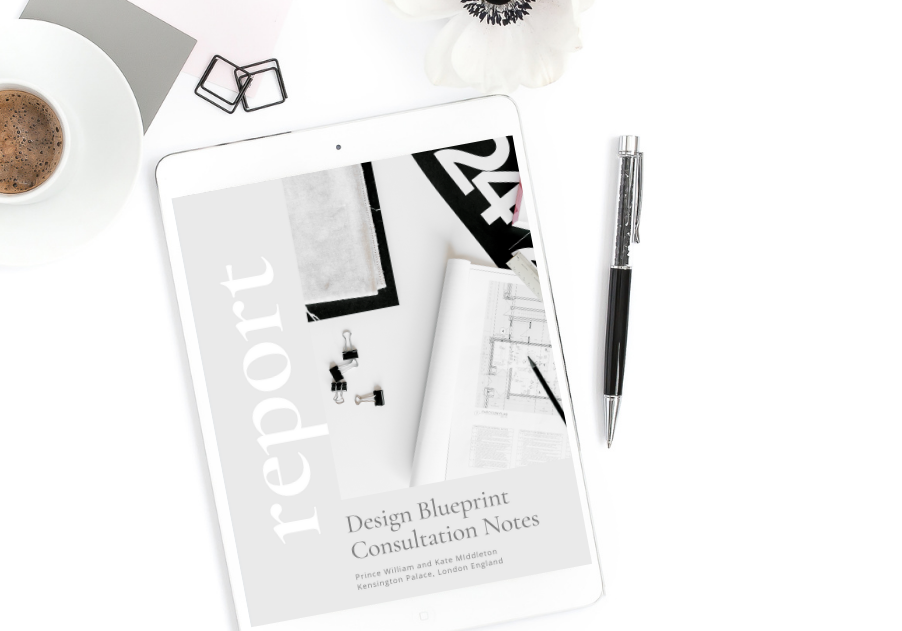
Digital copy of Design Blueprint Design Brief
The very foundation of a successful design project begins with the basic design brief. It is basically a short document that outlines the goals of the project as well as some of the challenges.
The design brief is then developed into what we refer to as the programming document. This document varies in length and detail depending on the complexity of the project. It could be a few pages or a few inches thick in a commercial project.
This document expands on the design brief and gives specifics about space allocation, adjacencies, budget, schedule, needs, wants, style, the existing space, and any challenges, goals, etc.
This is the result of a deep dive with clients. It is critical to really know and understand a client and what their goals and wants are, who they are as people and what they want their space to portray.
Once this document is fully defined and approved by the client, then the design phases begin and the documentation that goes with them.
Concept/Schematic Drawings and Mood Boards
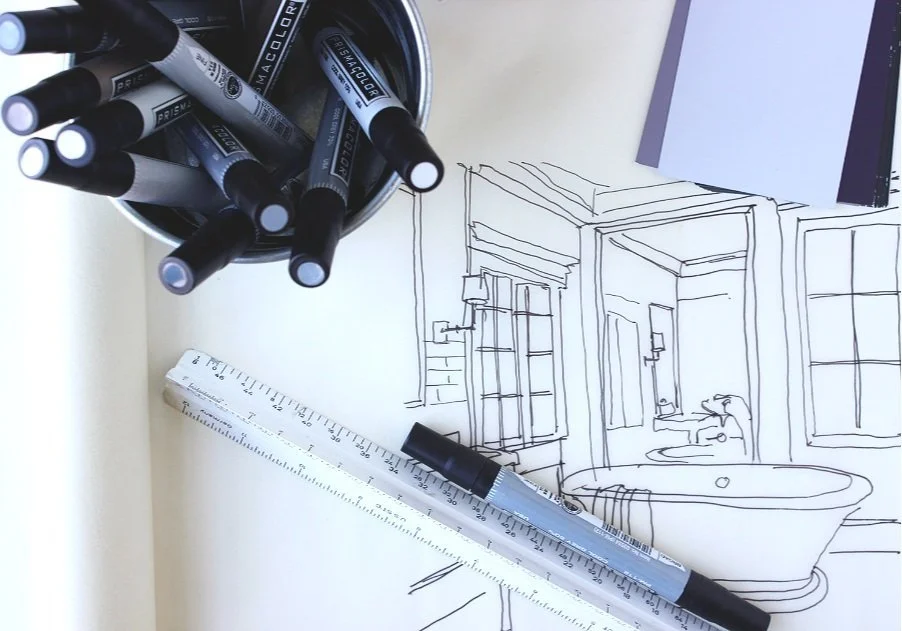
Loose schematic pen sketches of bathroom
So, like many things, design starts out rather macro. We begin with overarching concepts and schematic ideas. We begin blocking out spaces and refine them into a space plan which is a floor plan showing where various spaces, rooms, etc.. will be and their approximate sizes.
We may also do a concept board (recently being called a mood board, which is not to be confused with a furniture and finish board).
A concept board may show the beginnings of color palettes and textures and inspirational or “mood images” to give a conceptual direction. These are not literal materials and colors.
Once the concept and schematics are fine-tuned and approved, we move into design development where the concept is given a definitive and specific shape.
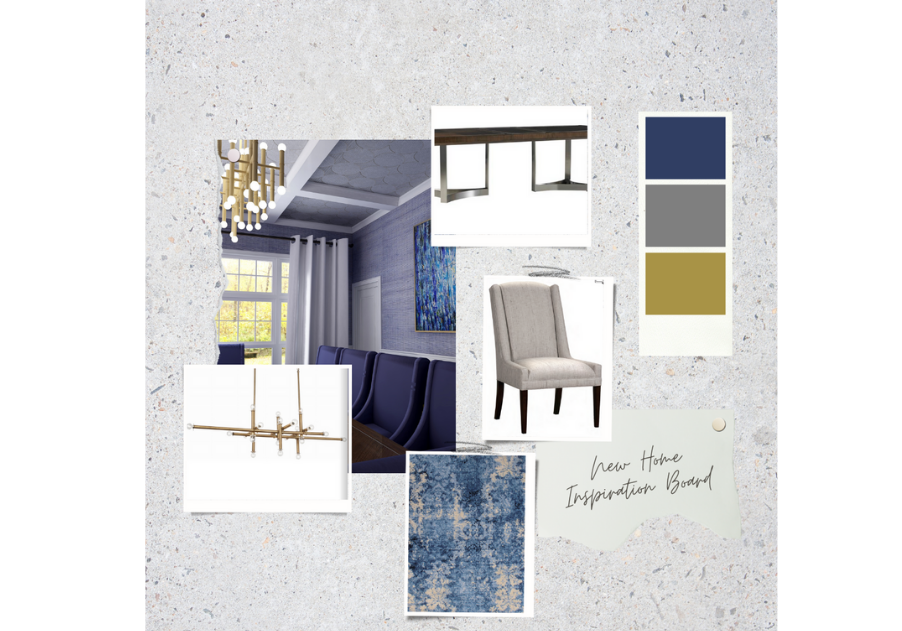
Mood board of proposed dining room
Design Development Drawings, Finish Boards, Samples, and Renderings
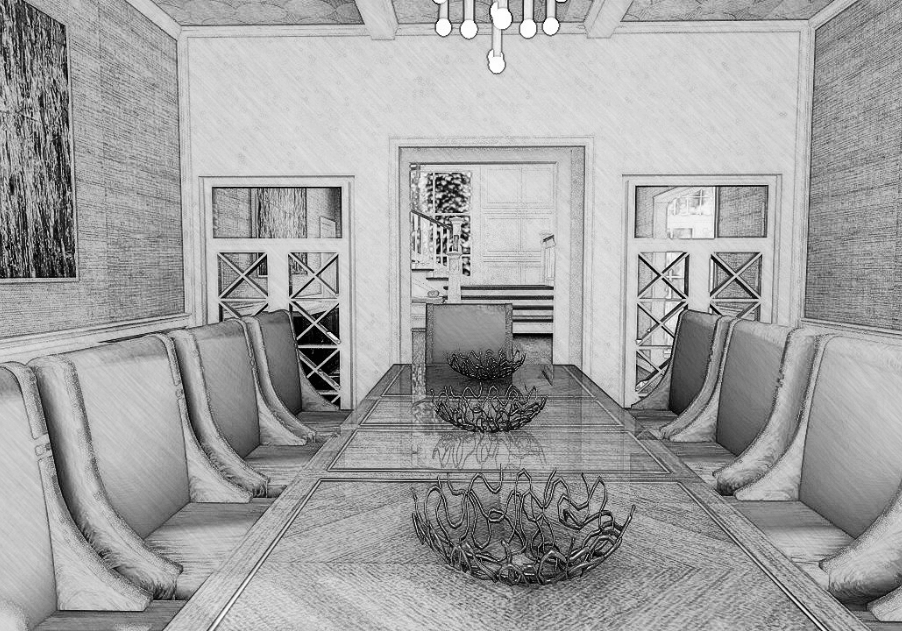
Pencil rendering of proposed dining room
After the concept and schematics are solidified, the design is developed into concrete terms. This means that all of the details are developed and designed.
All of the drawings needed to express what the final design will be are created such as renderings, elevations, floor plans, reflected ceiling plans, any specialty details like cabinetry, paneling, and various millwork drawings.
Furniture with specific fabric trim and details will be determined.
Architectural finishes will be decided on such as flooring, wallcovering, paint, stain stone, countertops, hardware, lighting and light fixtures, window coverings, and rugs.
These will all be a part of the big design presentation.
After the design presentation, any changes or revisions will be made. Once the design and final budget are approved, it is time to move into the start of the implementation phases.
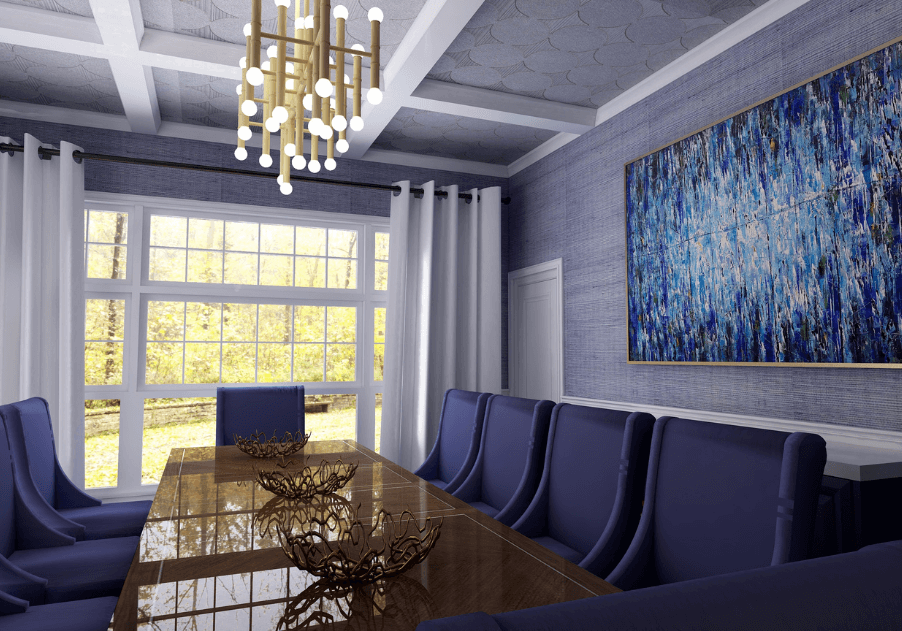
Photorealistic Rendering of a dining room
Construction Documentation and Specifications
Elevation detail of stairway paneling
After the design development phase, clients will have a very clear idea of what their spaces will look like, what specific pieces and finishes will be used, and the cost, but there is more documentation that needs to be produced to execute this design vision.
Showing any of the design documents to a contractor is really no different than showing them a photograph from the internet or a magazine.
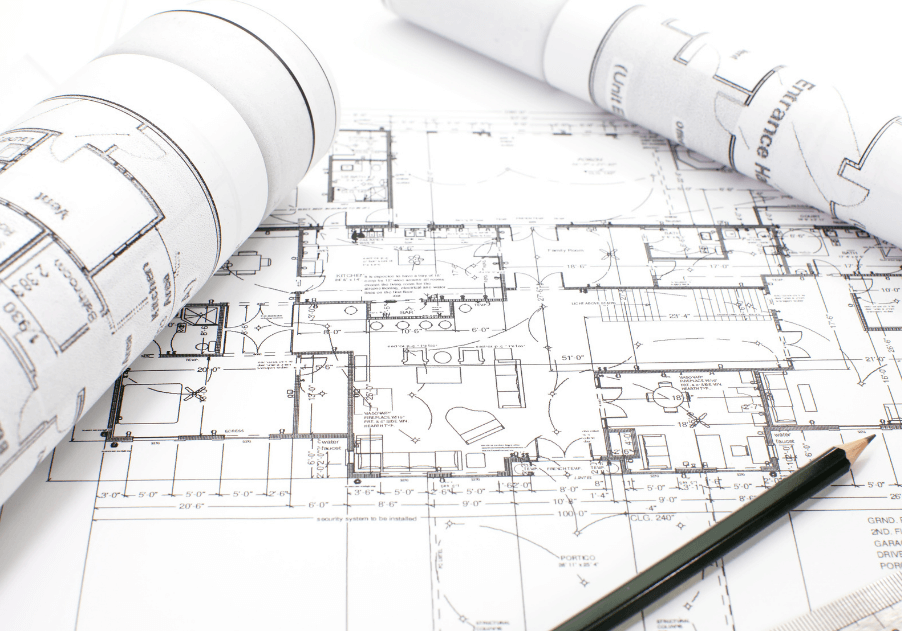
Construction documents-electrical plan
They need more information in order to build the space and to price it correctly This is where contract documentation comes in.
These are drawings that show specifically size, location, sometimes construction method, and details about how the space is to be built. Some people refer to them as “blueprints” but blueprints are actually a specific type of reproduction technique that was used prior to CAD and the use of laser printers.
Part of the construction documentation package is specifications. Specifications explicitly let the contractor know what products and materials are to be used in your projects so that undesired items are not substituted that could ruin the design intent or quality.
Additionally, at this point in the project, invoices and purchase orders will be generated for the purchase of fabric, furniture, and fixtures.
Generally, an invoice for a product is submitted to the client. Once a client approves and pays the invoice, the procurement process begins. Designers then purchase these items on behalf of the client.
Purchase orders are submitted and the designers coordinate the process of making sure goods arrive at the proper factories for fabrication.
Once goods are made and ready to ship, the designer coordinates freight to a receiving warehouse.
Unlike buying from retail stores or online, designers buy custom pieces directly from manufacturers.
Items are shipped from the factory on large trucks that have many furniture orders on them and can only be delivered to a facility equipped to accommodate these large trucks--as they can’t roll into your driveway.
So, designers arrange deliveries to receiving warehouses. These receivers also inspect and photograph the goods and note any damage or imperfections.
The designers are notified immediately and the situation is rectified, many times without a client ever being bothered.
The items are then stored properly until all of the other furnishings are delivered. Then at such time as construction is completed, The entire room or house of furnishings is delivered to the project site. This occurs on installation day.
While the ultimate design “deliverable” is a beautifully designed and functional space or home, there are many milestones and deliverables that occur along the way. These deliverables are crucial for communicating ideas as well as giving solid direction to vendors and contractors to ensure the design is then executed correctly.
Most clients love to see photorealistic renderings of their proposed space, and while these are exciting, it is crucial to not overlook the importance of construction documentation and specifications. These then explain and direct how a design will be built and come to life.
Interested in seeing how your home measures up? It’s the first step in creating your dream home…