The House that Never Let Go of a Detail
The House that Never Let Go of a Detail
Villa Necchi Campiglio, Milan · Piero Portaluppi, 1932–1935
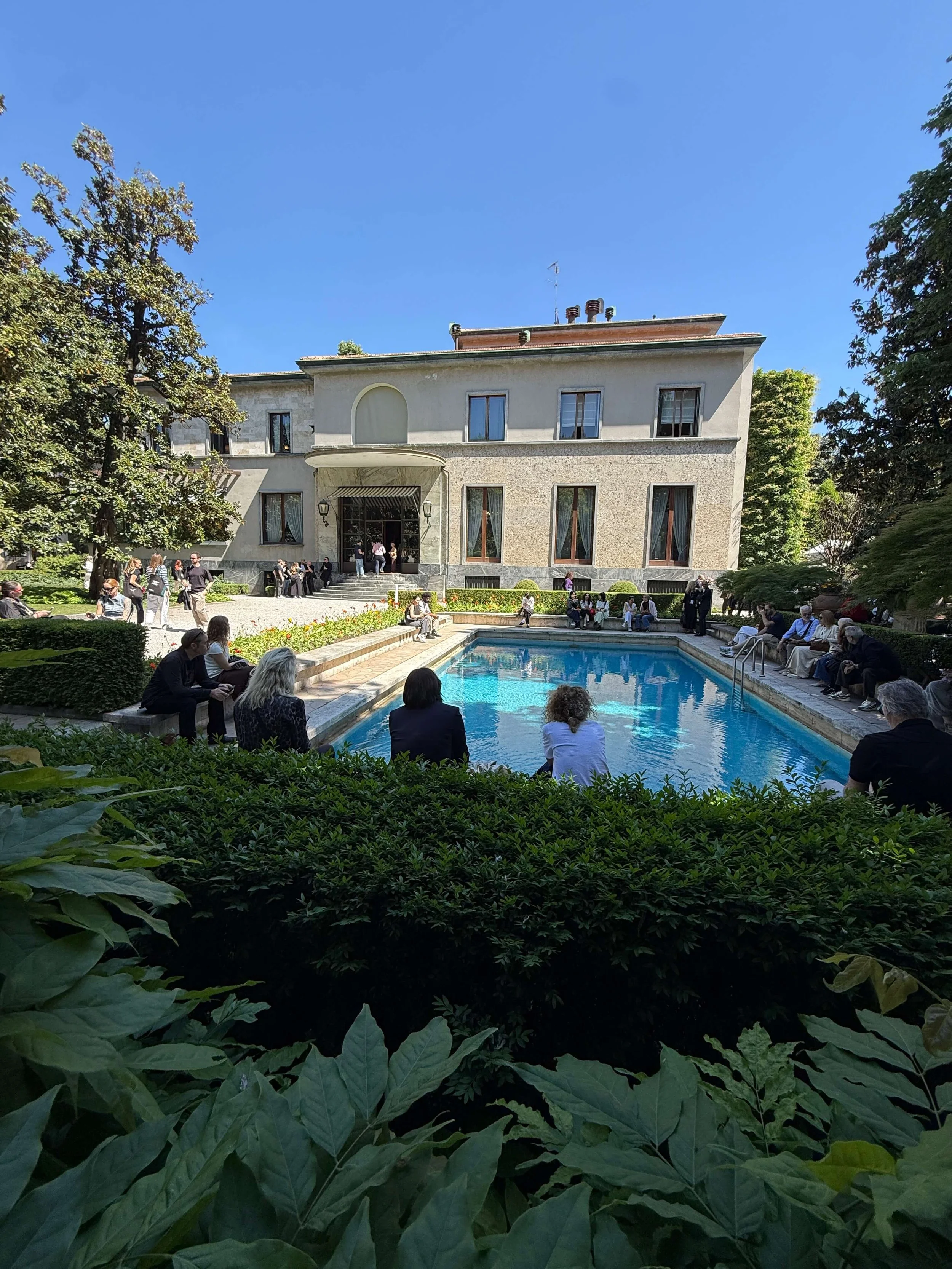
Villa Necchi Campiglio, Milan
The Necchi Campiglio family built their fortune on enamel, cast iron, and precision. When it came time to build their home, they chose an architect whose philosophy matched exactly what they already believed — that nothing should exist without a reason for existing.
. . .
Thanks for reading The Considered Home! Subscribe for free to receive new posts and support my work.
Two sisters, Nedda and Gigina, daughters of a wealthy industrialist, combined their inheritance with Gigina’s husband Angelo Campiglio upon their father’s death and invested in enamel and cast iron.
A House Built on Conviction
Precise, functional, industrial materials. Their brother split off and founded what became the iconic Necchi sewing machine company. This was a family whose fortune was built on function. Piero Portaluppi’s rationalist philosophy — light, efficiency, nothing extraneous — was not imposed on them. It was an expression of who they already were.
Rationalism, the architectural movement that emerged in Italy in the early twentieth century, rejected ornament in favor of scientific reason. Where Art Deco celebrated consumerism and glamorous expression, rationalism demanded that every element justify its existence.
The materials were reinforced concrete and glass. The thinking was rigorous. And yet — Villa Necchi Campiglio is not austere. It is glamorous. The sisters were known for being impeccably dressed and stylish. The house reflects that too. Portaluppi understood that rigor and warmth are not opposites. This piece is about how he proved it.
Gigina outlived both her husband and her sister. In her final years she made a decision that explains why I was standing in that garden on a Friday afternoon in April: she gave the house to FAI — Fondo Ambiente Italiano, Italy’s national trust — rather than sell it. No heirs. No auction. Just a woman who understood that some things are too important to keep. She died in 2001. What followed was three years of restoration and six million dollars — the goal to return the house to its rationalist roots.
The Rubelli family, Venetian silk weavers since the mid-1800s, restored and replaced the original textiles as part of that process. Which is how I came to have a member of the Rubelli family as my guide — a woman who could tell you not just what the fabrics were, but what they had been, and what it took to bring them back.
I arrived at Villa Necchi on the last day of a five-day itinerary arranged by ASID Metro NYC — private access to palazzi, showrooms, and installations across the city. Fendi Casa. Armani. Poltrona Frau. Trussardi. The Rossana Orlandi Gallery. It had been an extraordinary week. And then, after lunch in the garden, our guide walked us through the house her family helped restore.
· · ·
Milan 2026
Crossing the Garden
Before I even reached the door, something stopped me. The striped exterior awning. Cheerful, almost domestic — not what I expected from a rationalist masterpiece. It was the first indication that this house was going to be full of small surprises.
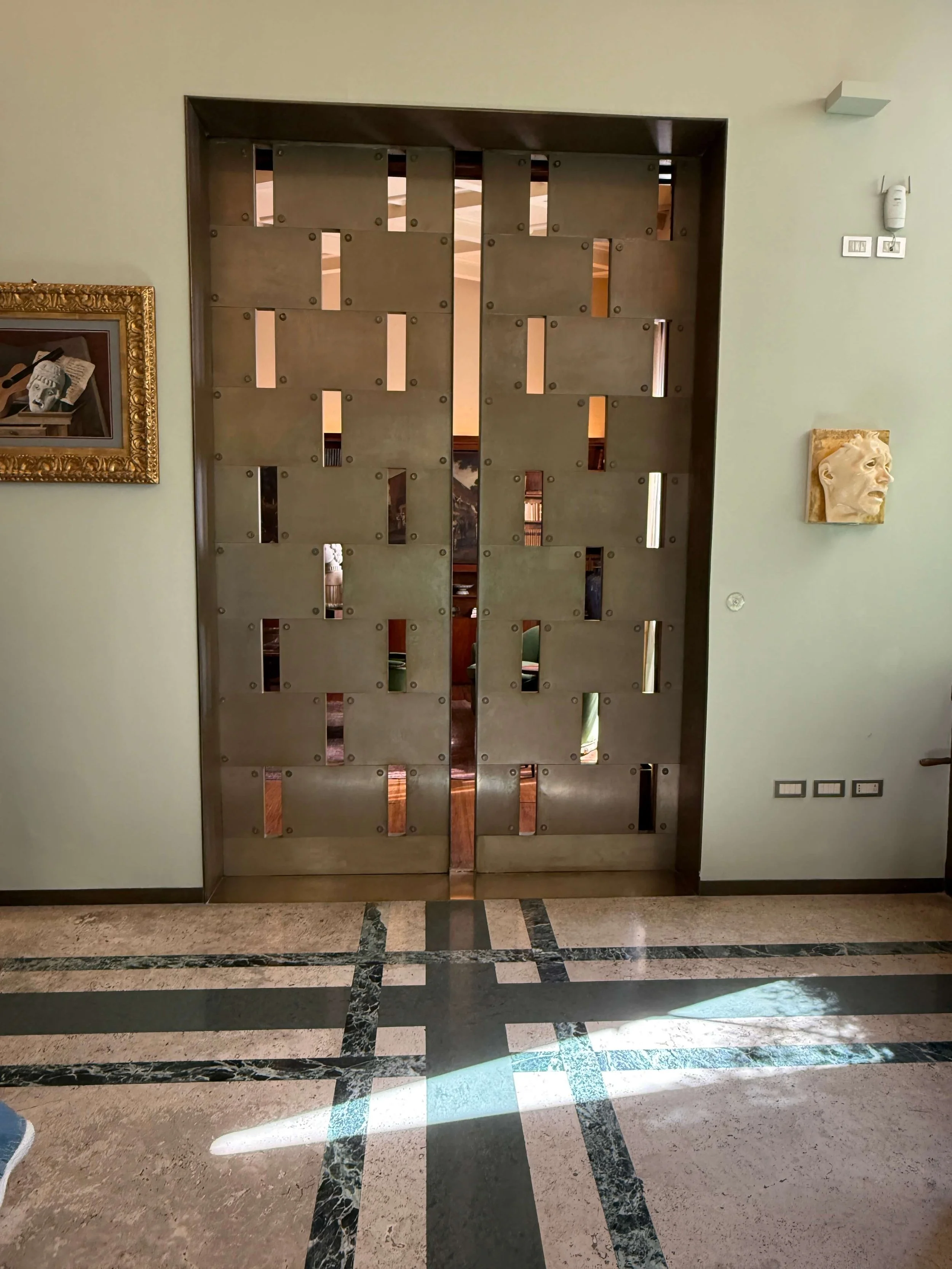
The approach is deliberate. You cross the garden past what was, at the time of its construction, the first private heated pool in Milan. Marble steps lead to large floor-to-ceiling brass-clad doors.
Elegant and refined without a trace of pretension. Inside the vestibule, a series of round recessed disc-shaped light fixtures line the ceiling — the first appearance of a motif that will follow you through every room in the house.
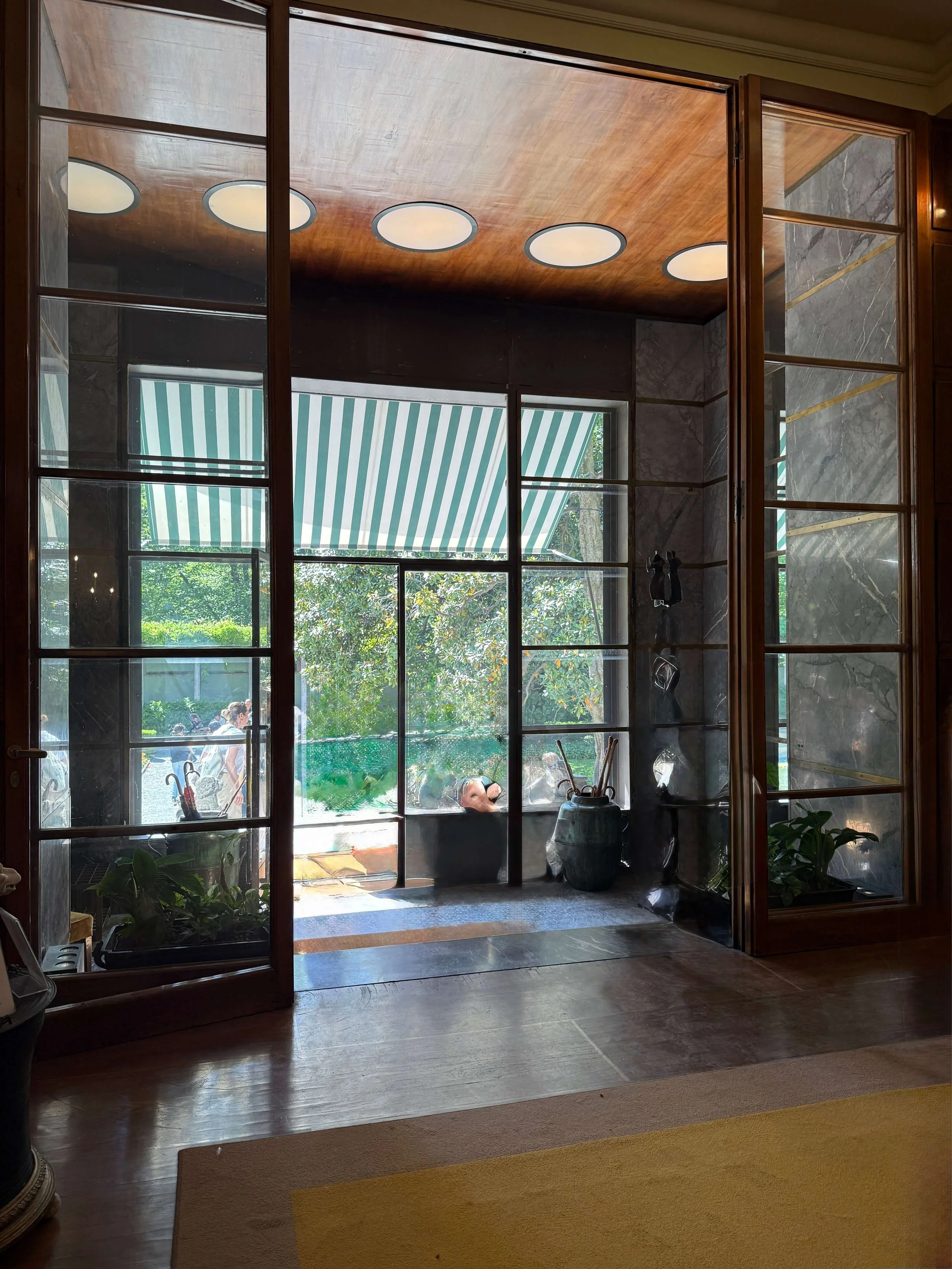
Entry at Villa Necchi Campiglio
The entry hall opens upward with high ceilings and an open staircase to the second floor. The rooms are arranged off a central axis — order without rigidity. The spatial logic is immediately legible. You know where you are.
Room by Room — What Portaluppi Actually Built
The library spans across the central hallway, connecting both sides. Built-in bookcases, game tables, leather-bound books, family photographs. Portaluppi restrained the ornament but not the ceiling — here he created a ribbed lattice pattern, painted a quiet white, that gives the room texture without weight.
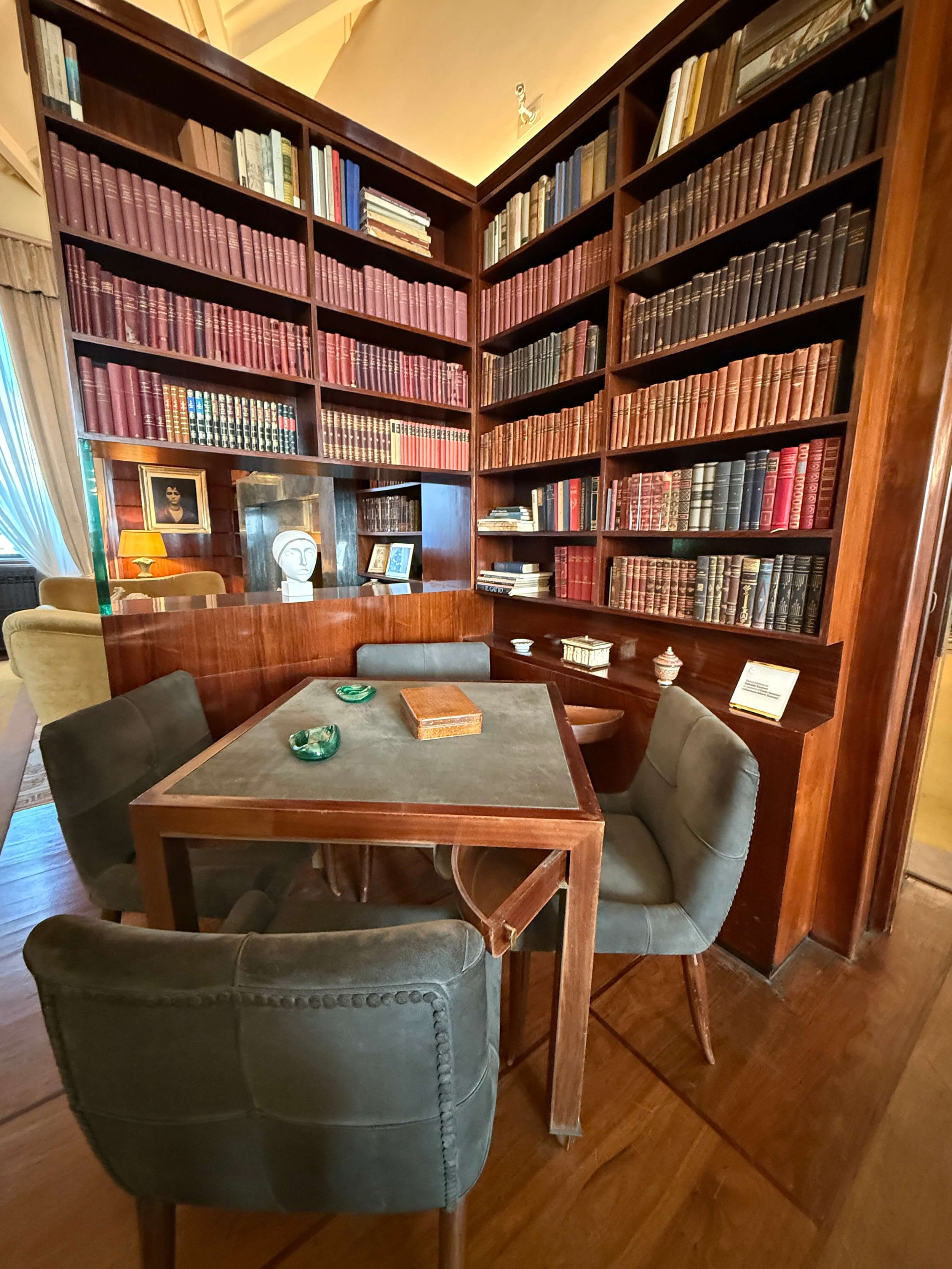
Library Corner
It was in this room that I had my first personal recognition: the paneled walls with reveals are a detail I have specified in commercial interiors for years. Seeing it here, executed in 1935, was the first moment I understood that Portaluppi wasn’t being modern. He was simply being right.
The living room is the most formally European space in the house — eighteenth century furniture decorated by Tomaso Buzzi, whose original interior sketches survive in the historic trust archive.
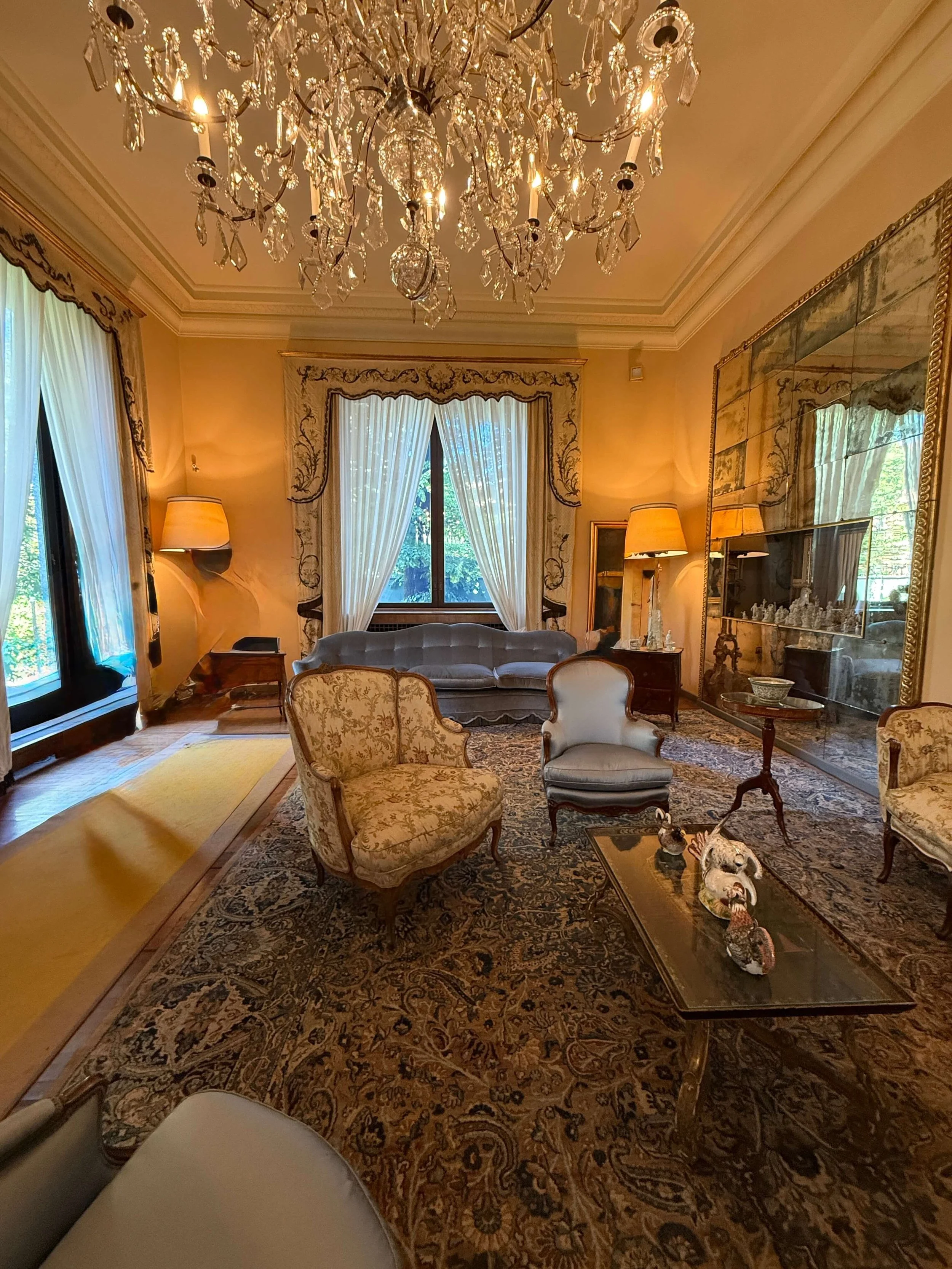
Living Room
“Everyone photographs the barrel ceiling. I keep thinking about the slipcovers.”
Across the central hall, open to it, is the veranda. Garden-facing. Wrapped on two sides by Portaluppi’s double-paned glass walls — plants growing between the layers, the system providing thermal insulation and buffering the noise of the city beyond.
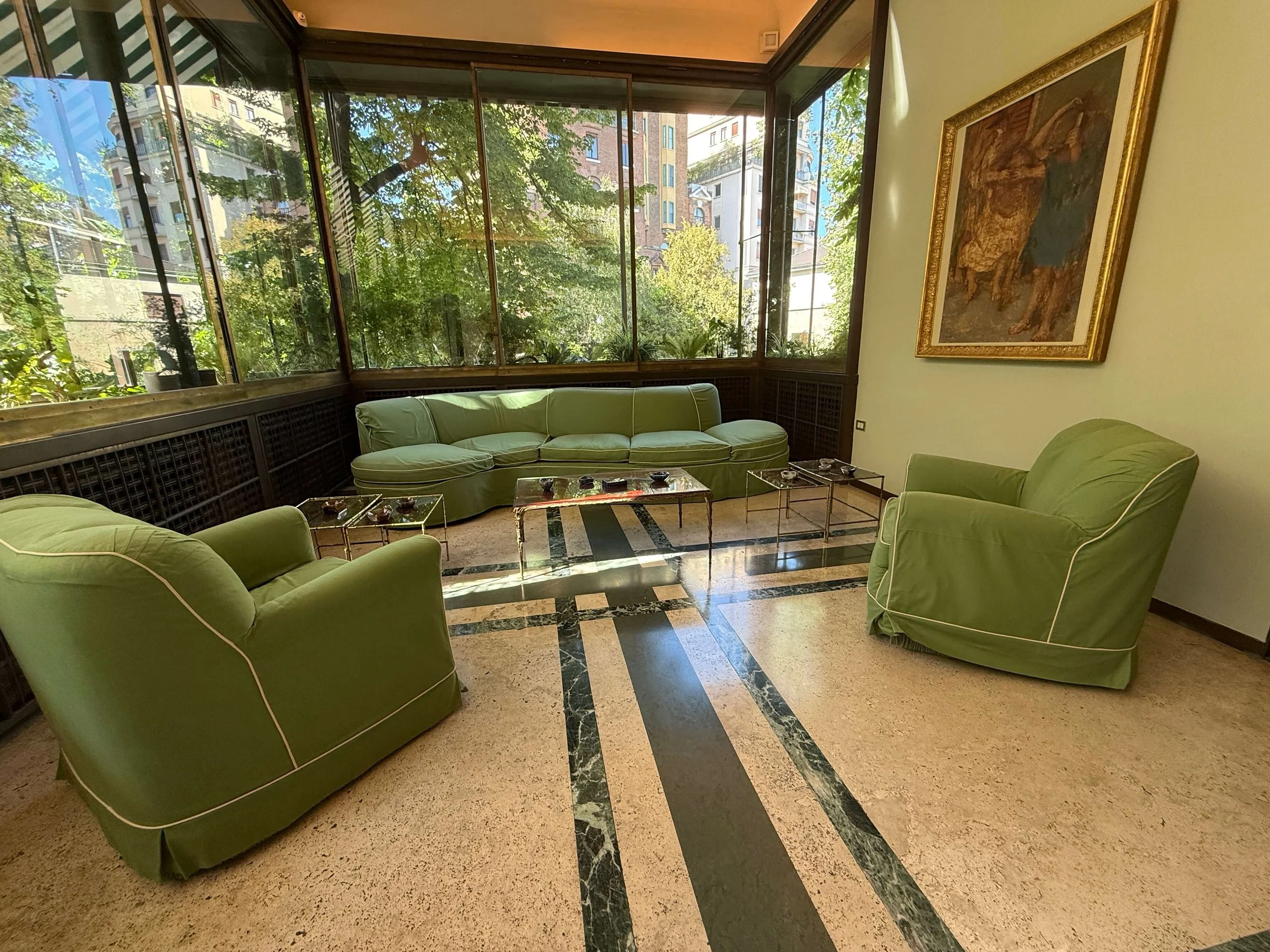
Veranda
The brass hardware on the frames is simple and extraordinary. Two massive German silver sliding panels separate the veranda from the library when needed.
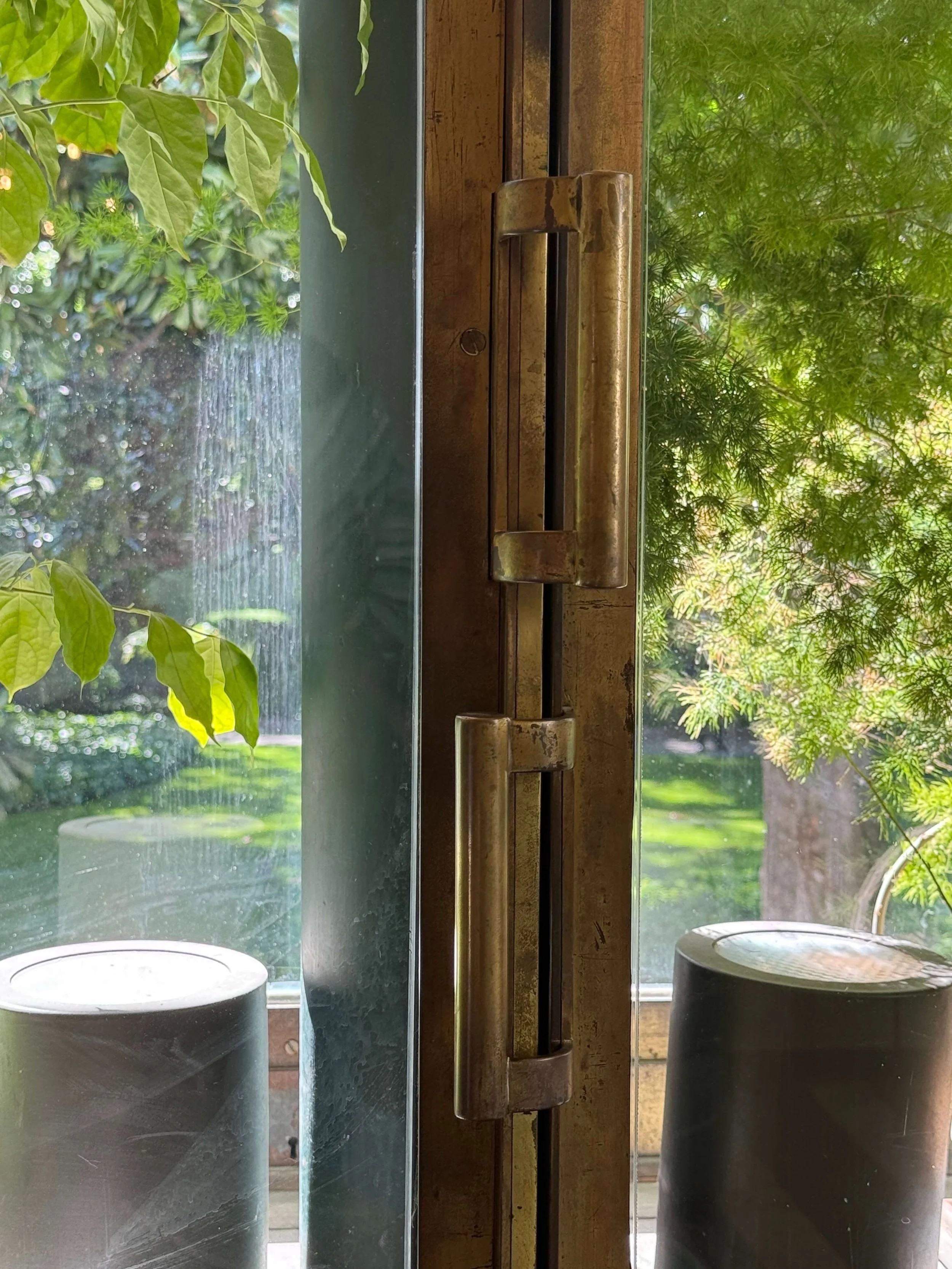
Detail of brass hardware pulls on sliding windows
German Silver pocket doors in veranda
“Everyone photographs the barrel ceiling. I keep thinking about the slipcovers.”
The sofas in the veranda are covered in simple green cotton with white welting. On formally scaled furniture, in a house of this precision and pedigree, slipcovers. The reason is practical: guests coming in from the pool. The house was meant to be lived in.
The Detail He Never Let Go
Portaluppi — who designed every rivet, every porthole, every motif — also understood that a beautiful space must forgive you for being human in it. That’s not a compromise of the rationalist philosophy. That is the rationalist philosophy, applied to domestic life.
The travertine floor is inlaid with intersecting bands of green marble. The ceiling carries cove uplighting held just back from the crown, creating a soft ambient glow. It is a room that manages to be both precise and completely at ease.
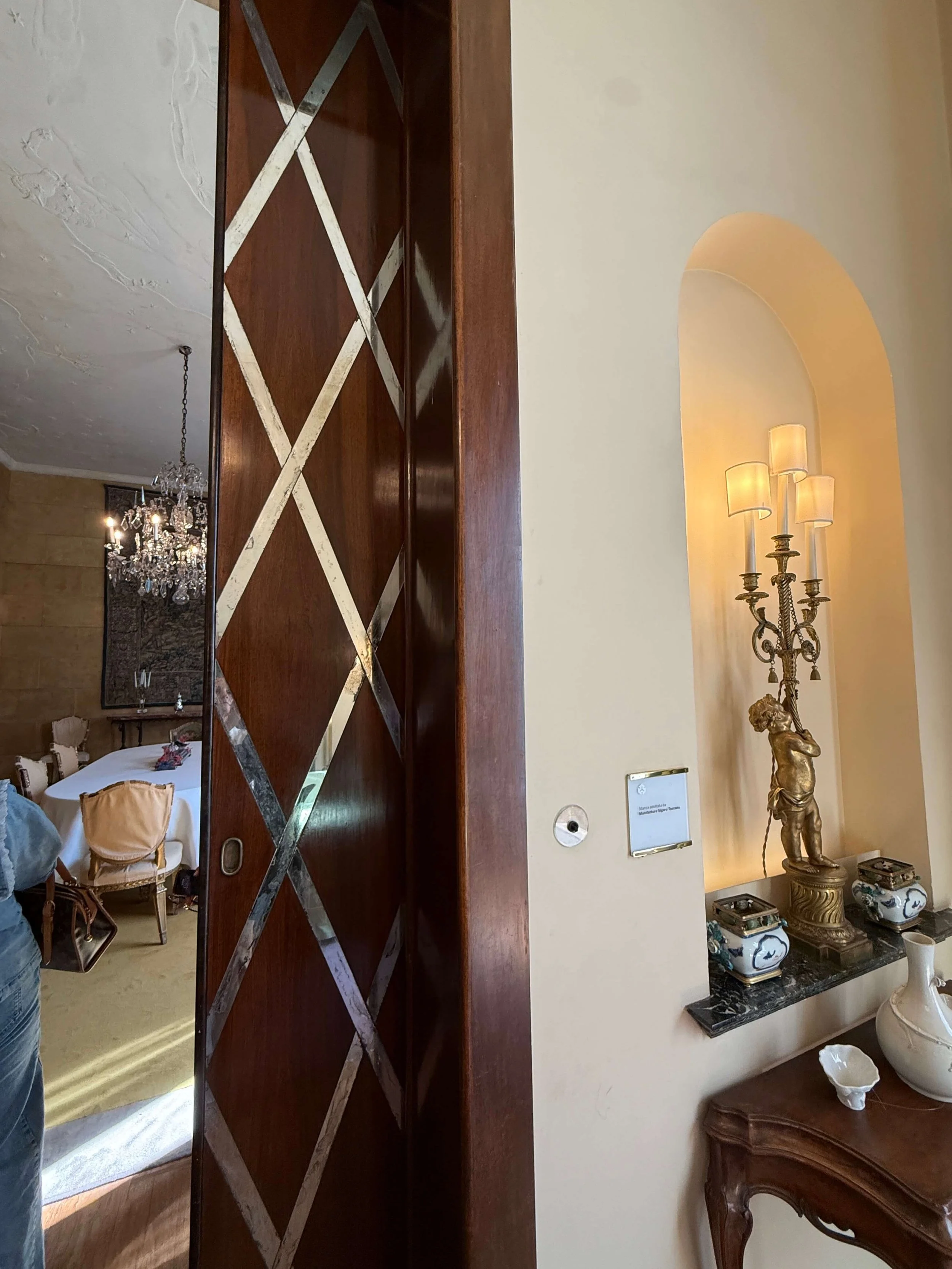
Mirrored diamond motif on mahogany pocket doors.
The study is quietly masculine — rosewood paneling with reveals, one of which conceals a safe. The smoking room’s pocket doors are extraordinary: Portaluppi’s lozenge mirror motif, diamonds defined in mirror against a mahogany ground, is a detail that could have been designed yesterday. The formal dining room carries parchment paneling, a stucco ceiling with natural motifs, a crystal chandelier — and slipcovers on the dining chairs. Even here.
In the butler’s pantry, Portaluppi designed the china himself, incorporating the C for Campiglio. He was not a man who considered anything beneath his attention.
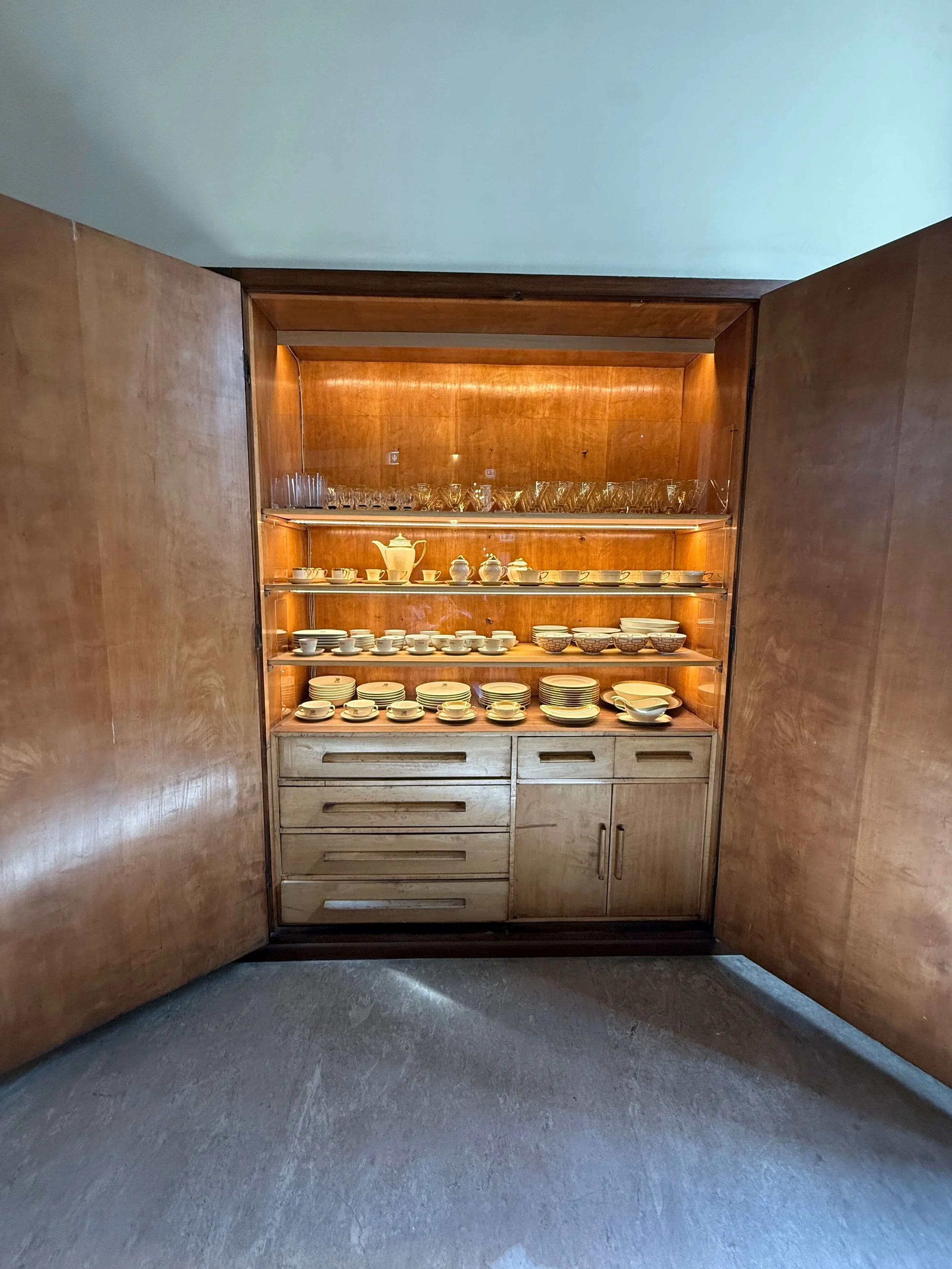
Dish storage in butler’s pantry.
By the time we reached the upper floor, I had begun to notice the pattern. The round disc motif from the entry vestibule reappears in the marble showers — cut high on the wall to release steam.
The rivets holding the marble panels in place reappear exactly when the material transitions to mirror, maintaining the rhythm without missing a beat. The barrel vault ceiling in the owners’ bedroom hall carries a rope and tassel detail.
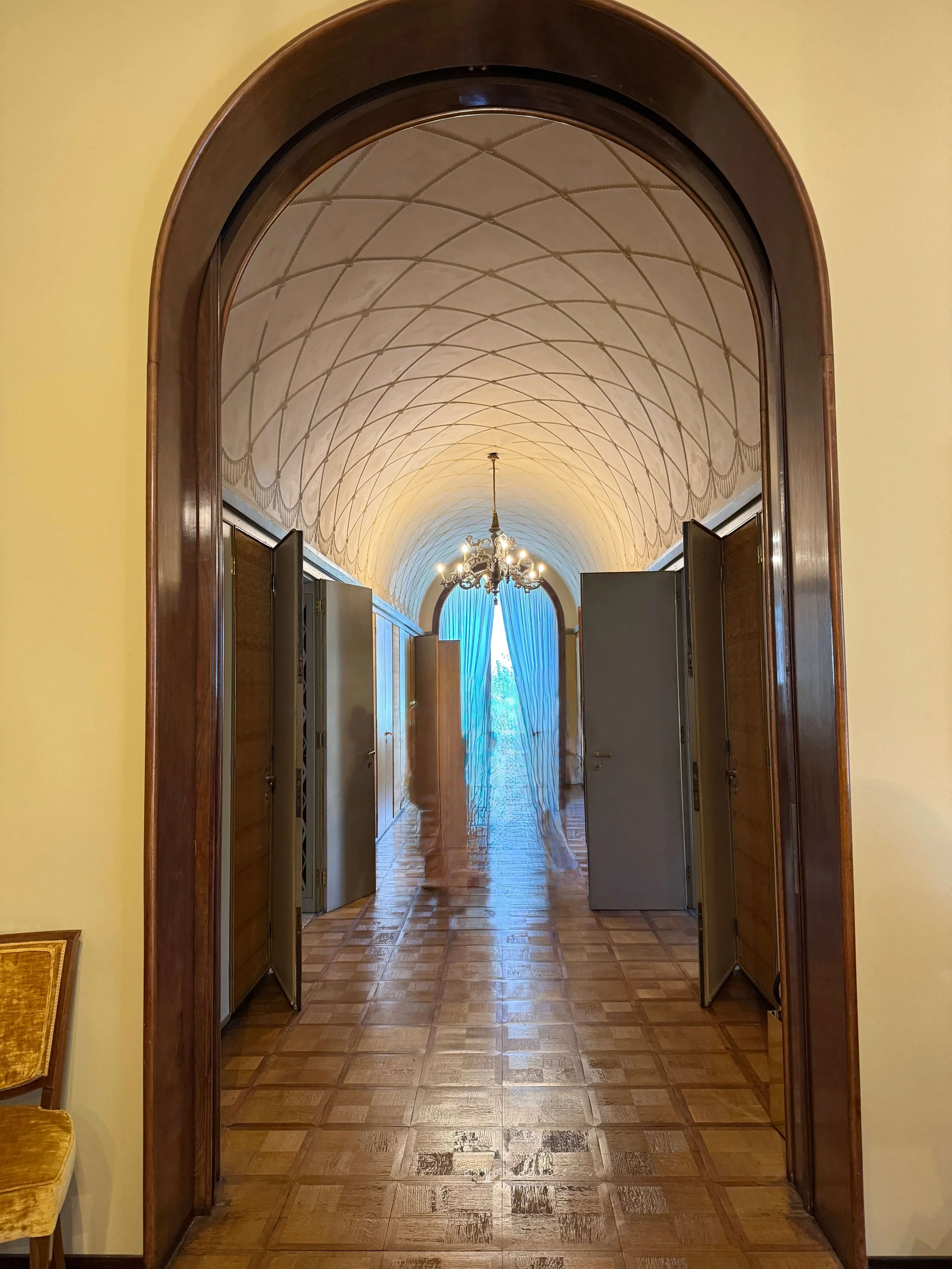
Barrel vault ceiling with tassel detail in the owners bedroom hallway. All of the doors are closet storage or entry to each of the two bedroom suites.
The star motif appears in the bathrooms on the front facade, symmetrically placed. Portaluppi introduced a visual language at the front door and never abandoned it — through every room, every material, every scale shift. That’s not repetition. That’s conviction.
· · ·
What the Walls Held
Walking back out through the vestibule into the garden, I stopped at the pool. The city oasis. The beauty of it held quietly in the middle of Milan.
The house had not always been easy to hold onto. During the war the family had the foresight to remove the artwork before the occupation. When they returned, the house itself was in rough condition — worn by years of use it was never meant for. The restoration that began in 2001 was not simply cosmetic. It was an act of recovery. Of returning something to what it had always meant to be.
“The walls held all of it — the precision and the slipcovers, the rationalist rigor and the crystal chandelier.”
"The walls held all of it — the precision and the slipcovers, the rationalist rigor and the crystal chandelier."
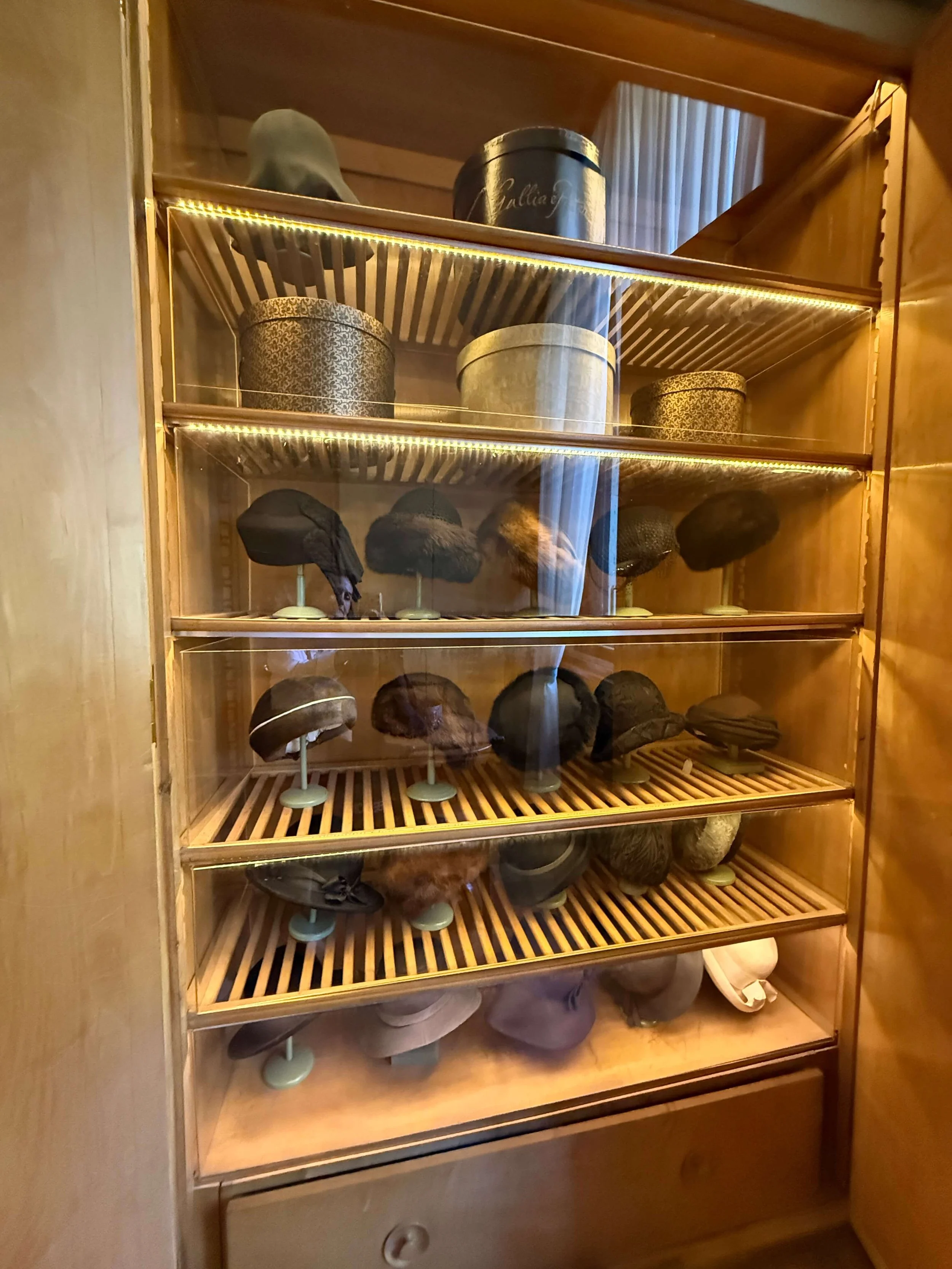
Hat storage
Three people lived here together until their deaths. One of them decided it belonged to Italy. The walls held all of it — the precision and the slipcovers, the rationalist rigor and the crystal chandelier, the glamour of two impeccably dressed sisters and the weight of everything those walls witnessed.
“That’s what the best spaces do. They hold the full complexity of the lives lived in them without resolving the contradiction.”
Portaluppi never abandoned a detail once he committed to it. That’s not a stylistic choice. That’s a philosophy. The right language first. The right room eventually.Plot Twists, Pivot Points, and the Beauty of Starting Over.
Are you looking for some quick interior design wins? Grab a copy of the 7 common interior design mistakes.