“The Double Take” — Ai Weiwei, Rubelli, and What Silk Can Carry
Not a Tourist. Mostly. — Milan 2026 Rubelli Showroom, Via Fatebenefratelli
Milan Design Week 2026
Rubelli Showroom, Milan
Rubelli has been weaving silk in Venice since the mid-1800s. They have dressed royalty, clothed La Scala, and restored the textiles of one of Milan’s greatest private homes. They are not a house that makes provocations. Which is exactly what makes this one so extraordinary.
For Milan Design Week 2026, Rubelli presented Ai Weiwei: About Silk — an immersive installation born from a collaboration between the Chinese artist and activist and a Venetian textile house that predates his government’s existence by several decades.
I visited the showroom on Via Fatebenefratelli on the last Friday of Design Week, the morning before my visit to Villa Necchi Campiglio. I walked in not entirely sure what to expect.
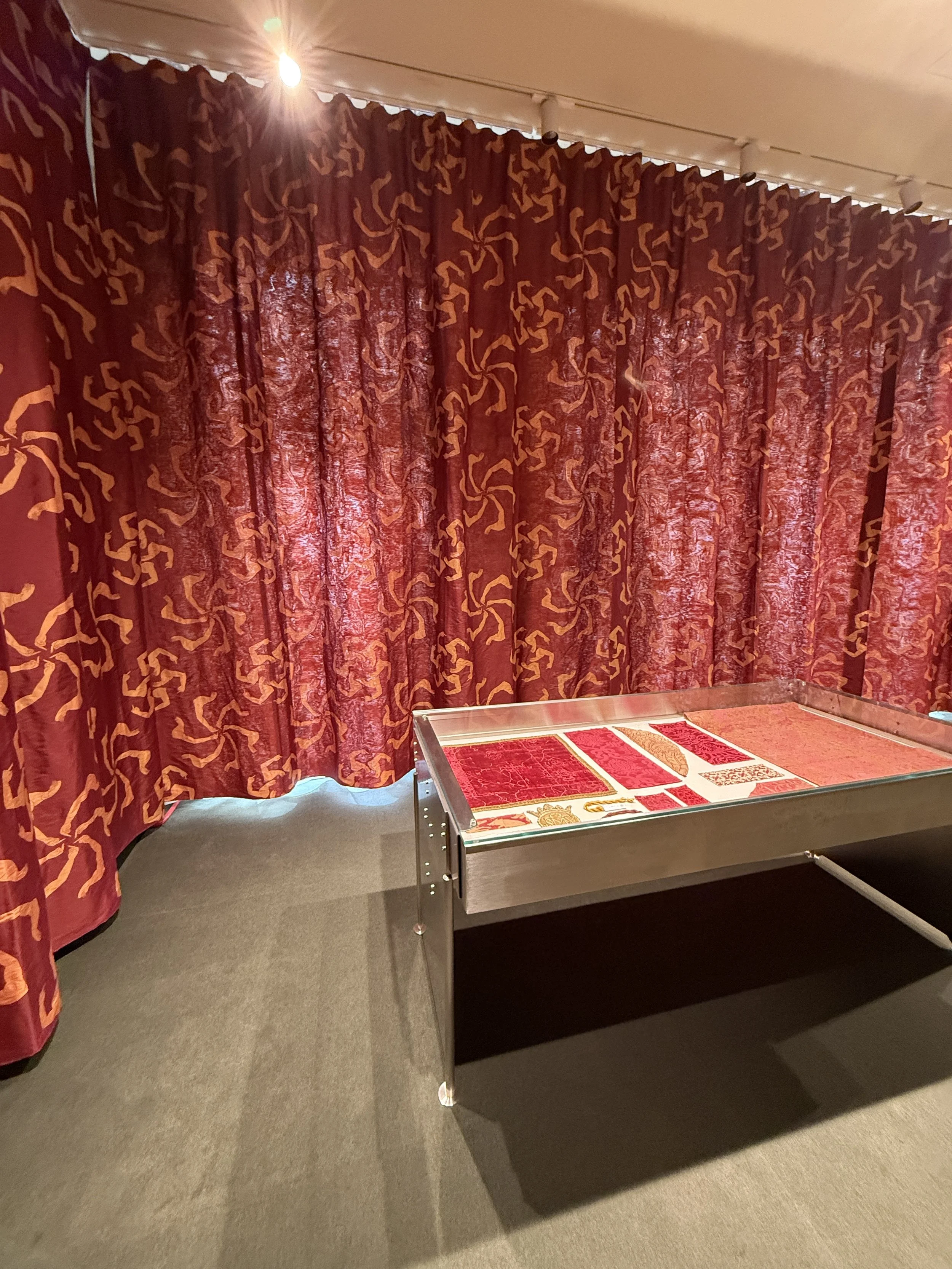
My first impression was archival. Rich red ground, gold metallic thread, a large-scale repeat pattern with the kind of authority that comes from centuries of refinement. The silk hung floor to ceiling around the room.
The weight of it, the lustre of the metallic thread, the monumental scale of the repeat — everything said this is what Rubelli does. This is what they have always done. My eye, trained over thirty years to read a room in the first few seconds, read this one as historic. As expected. As exactly right.
It wasn’t until I looked closer — the way you look at a Rorschach test when the image suddenly shifts — that I understood what I was actually looking at.
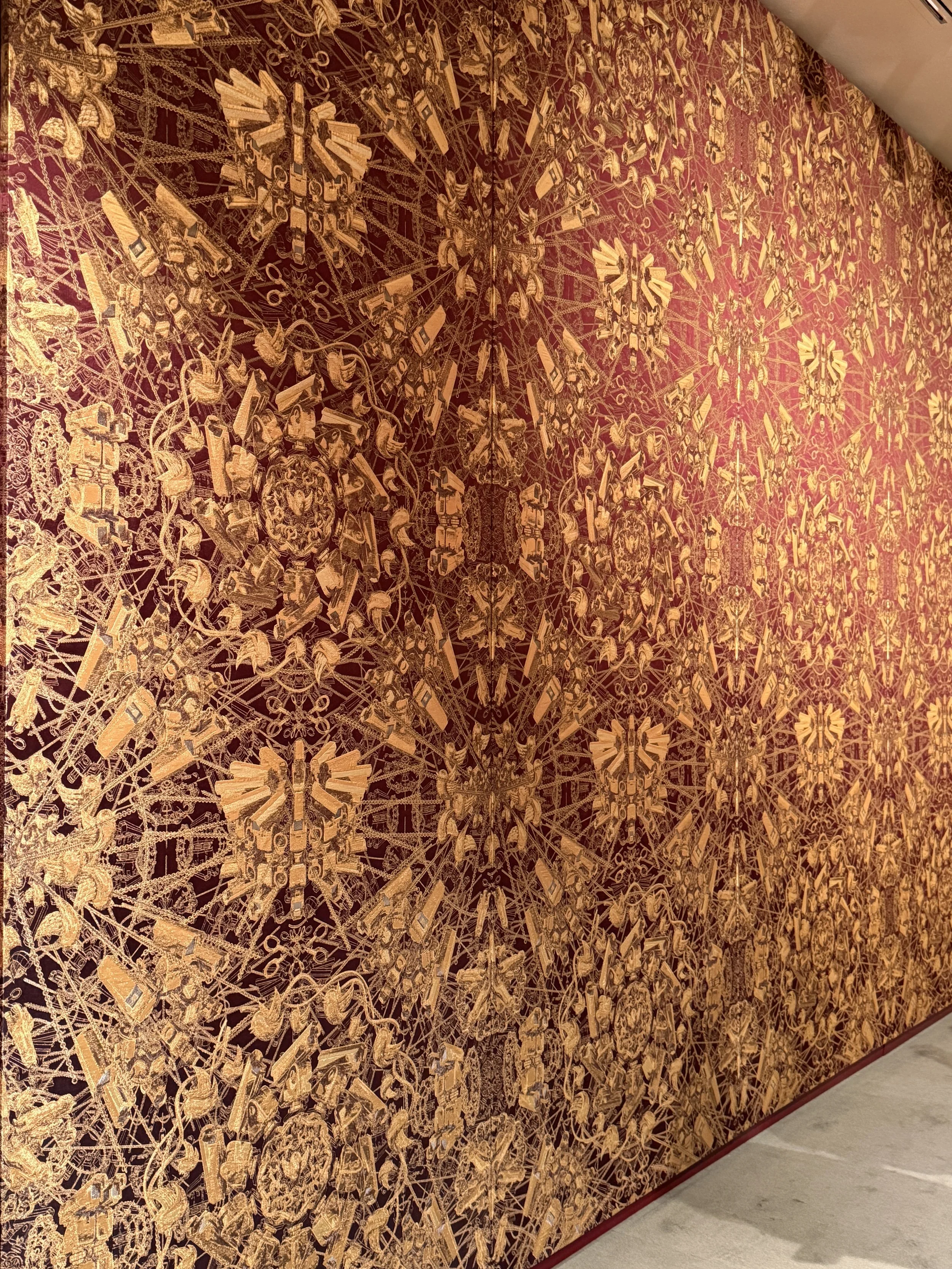
Rubelli showroom, Milan
The ornamental repeat was not floral. It was not historical in the way I had first assumed. Woven into the silk were surveillance cameras, handcuffs, chains, the Twitter bird, and the strange, almost comic alpaca/llama figure that has become part of Ai Weiwei’s visual language of resistance.
And arranged in a circular pattern, arms radiating outward like a decorative rosette, a gesture so universally understood it needs no translation. The symbols were not hidden, exactly.
They were right there. But the beauty of the material had softened them first. It had given my eye permission to accept them before my mind had time to object.
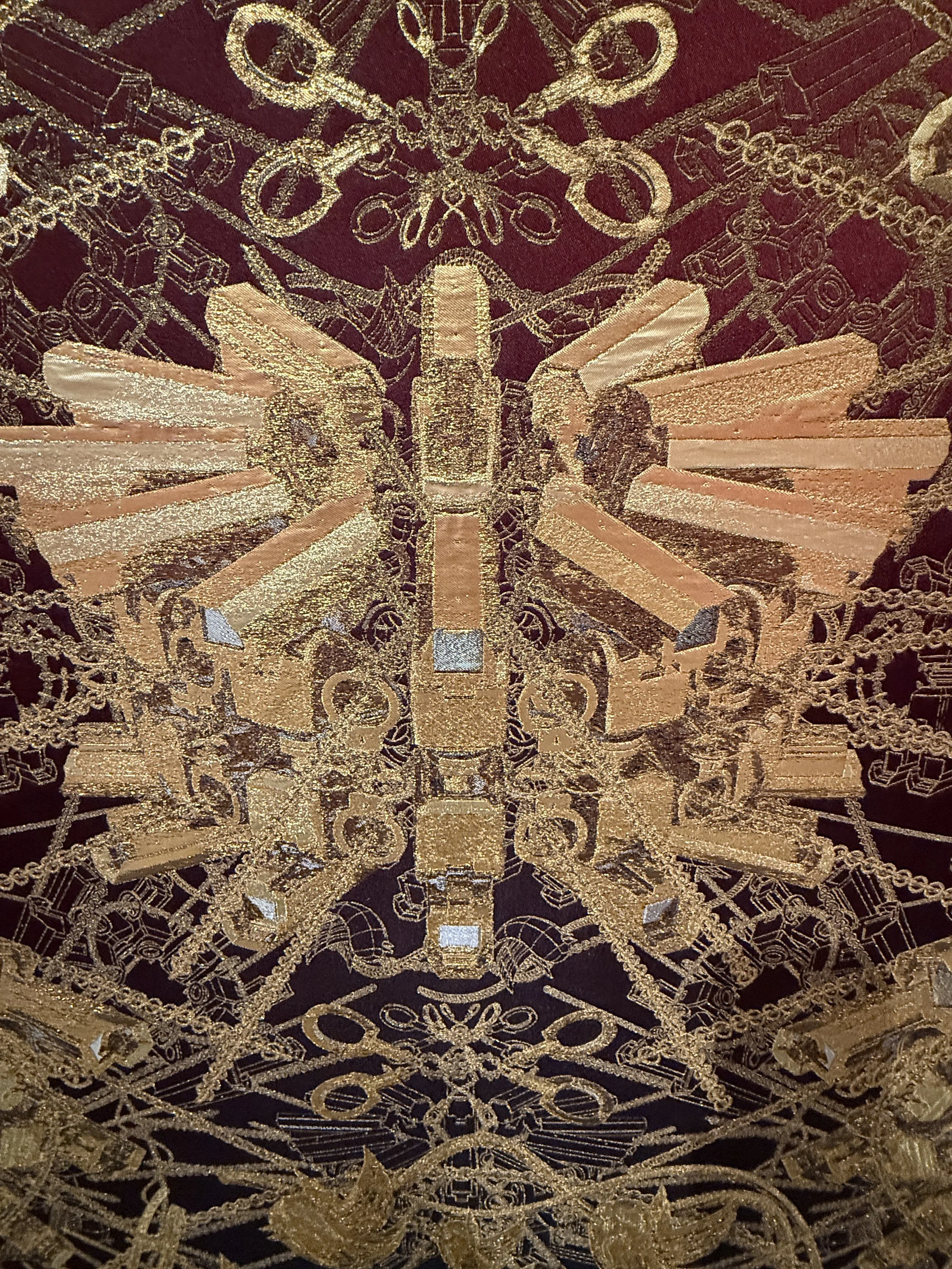
Detail Ai Weiwei Design
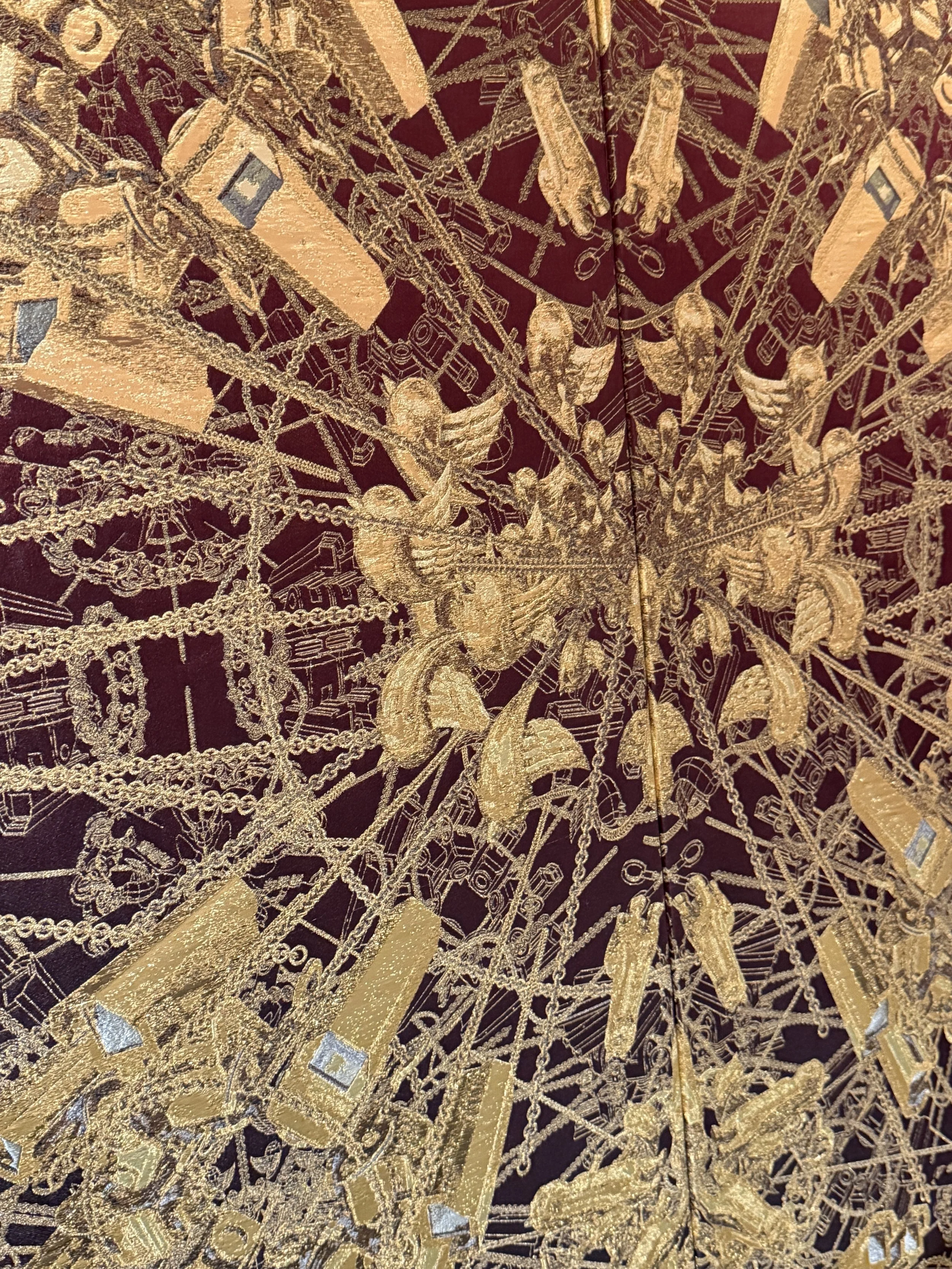
Ai Weiwei Twitter bird detail
Beauty has always had the power to normalize. It can make authority feel inevitable. It can make hierarchy feel elegant. Propaganda has always understood this.
So has luxury. Give something the right scale, the right material, the right craftsmanship, the right amount of gold thread, and the viewer may admire it before they interrogate it. We are trained, especially in beautiful rooms, to trust what has been so carefully made.
But Ai Weiwei reverses the mechanism. He takes the visual language of power and luxury — silk, gold, grandeur, a Venetian textile house with centuries of cultural authority behind it — and asks it to carry a message against power.
The surveillance camera becomes beautiful. The handcuff becomes ornamental. The Twitter bird, woven by a house that predates Twitter by more than a century, suddenly carries the weight of what that symbol once meant to people trying to speak when speaking was dangerous.
“It is not beauty as distraction. It is beauty as trapdoor. You fall through the loveliness into the truth underneath.”
At the center of the room sits a sofa, upholstered in the same silk as the walls. Angular, architectural, strange in its proportions. Its lines converge and narrow, quietly directing your eye — and your body — toward the rear of the installation.
It was the only piece of furniture in the room, and because of that, it had a kind of gravitational pull. You were not simply invited to look. You were invited to sit.
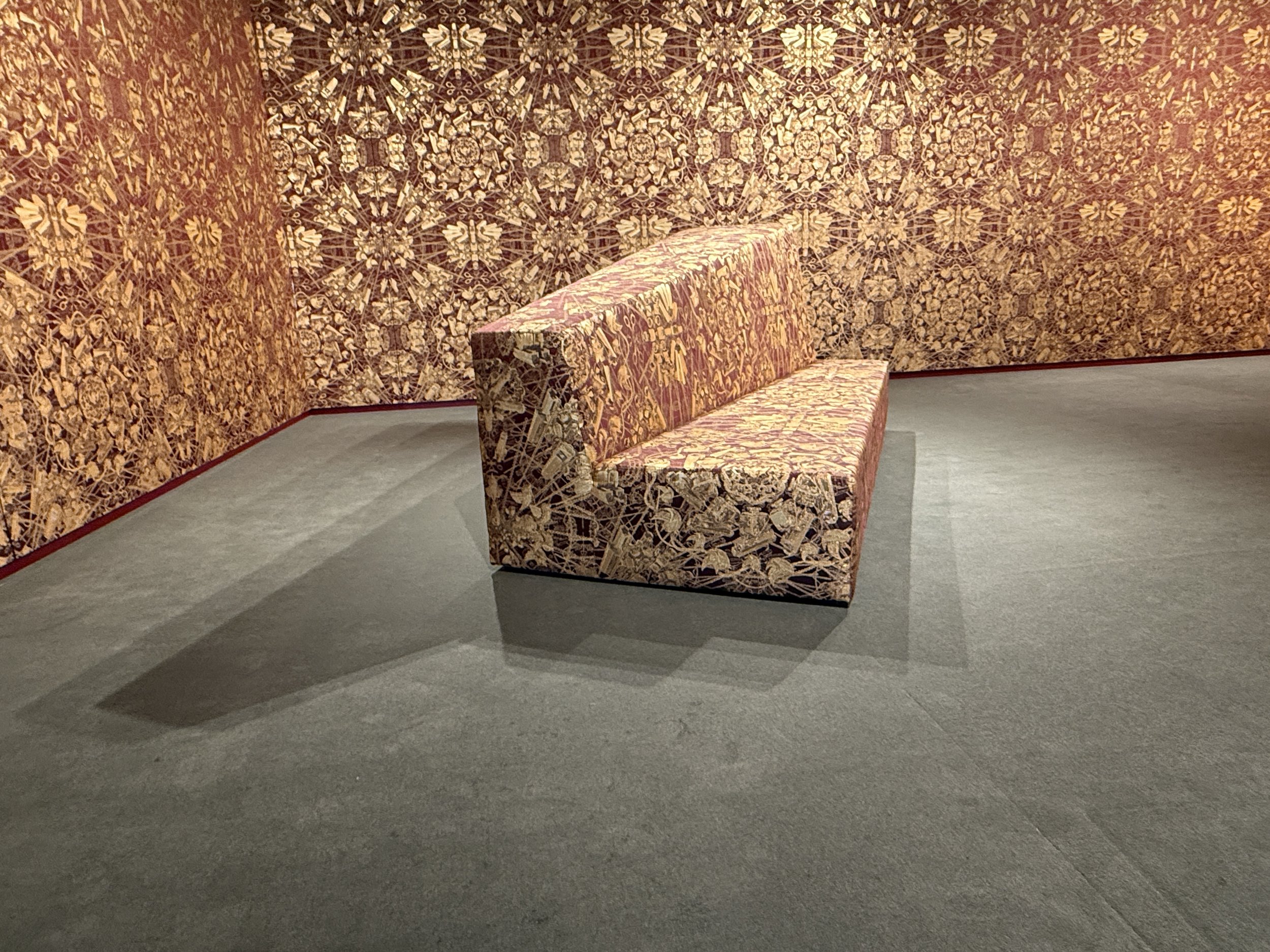
Rubelli Showroom
Which changes everything.
Because when you sit, the surveillance cameras are beneath you. The message is at your back. The room is no longer something you are observing from a safe, tasteful distance.
You are in it. On it. Part of it. The double take is no longer just visual — it becomes physical. You have accepted the beauty, accepted the comfort, accepted the invitation — and only then do you realize what you have agreed to inhabit.
That is where, for me, the installation moved from art object to room. Even protest, when brought into the language of interiors, has to be lived with.
The sofa still has to function as a sofa. The fabric still has to fall, wrap, shimmer, and hold. The room still has to pull you in. That is not a compromise. That is what design can do that pure image often cannot. It does not simply tell you what to think. It asks you to occupy the question.
The Process Behind the Provocation
As always, the process is the most interesting part of a design. In the back room were iterations — strike-offs in varying colorways, each combination shifting the feel of the work entirely. The decision to go with scarlet and gold was not accidental.
Those are the colors of royalty, of ceremony, of things we are trained to revere. Against that backdrop, the surveillance cameras don’t look like surveillance. They look like they belong. Which is worse.
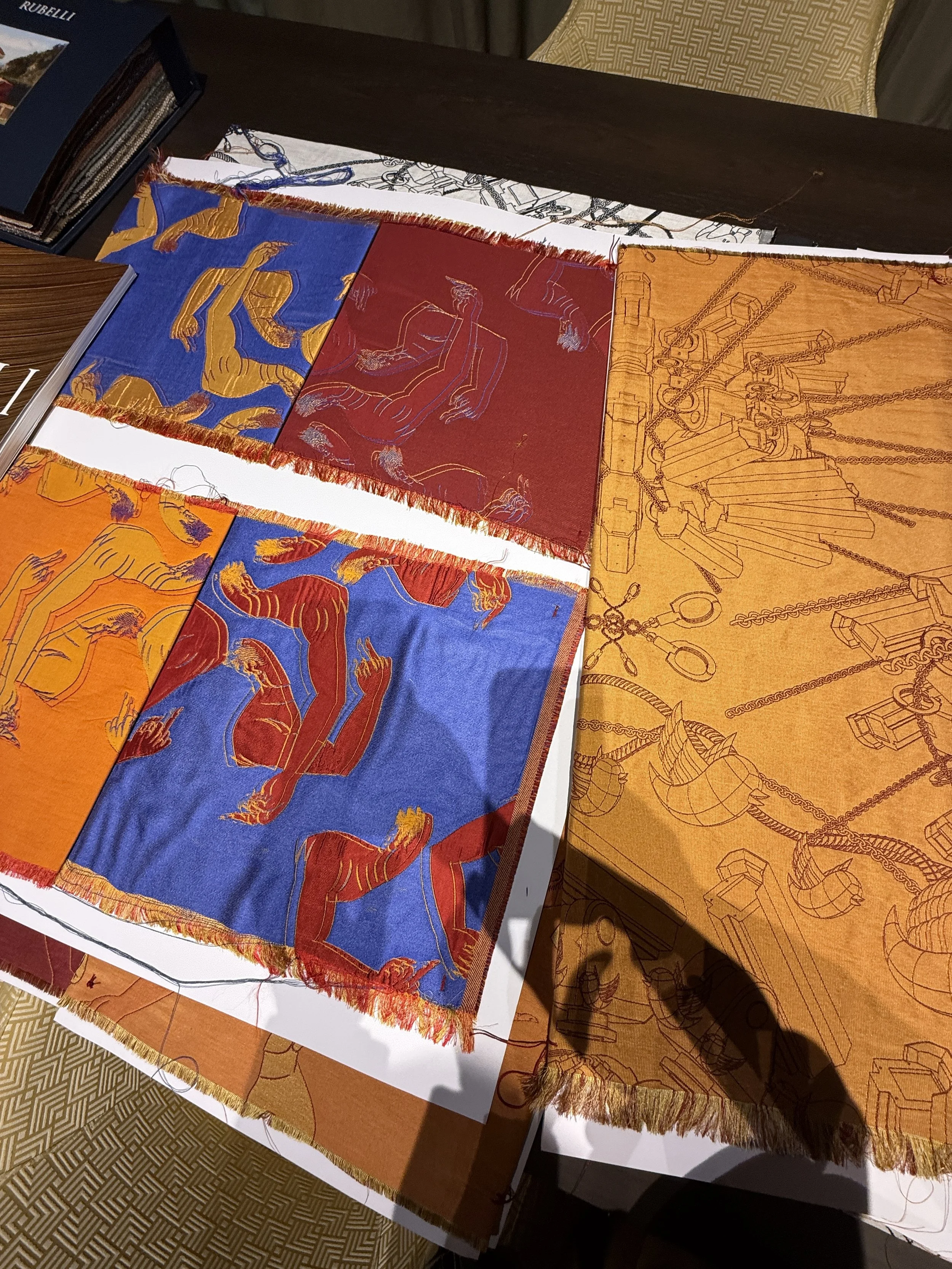
Colorways
There was also a fabric done in white with the circular arm motif rendered in grey — a sheer, lightweight cloth with a palette so quiet it could hang in any beautiful home without announcing itself. Most people would never know what they were looking at. Which is, perhaps, its own kind of double take.
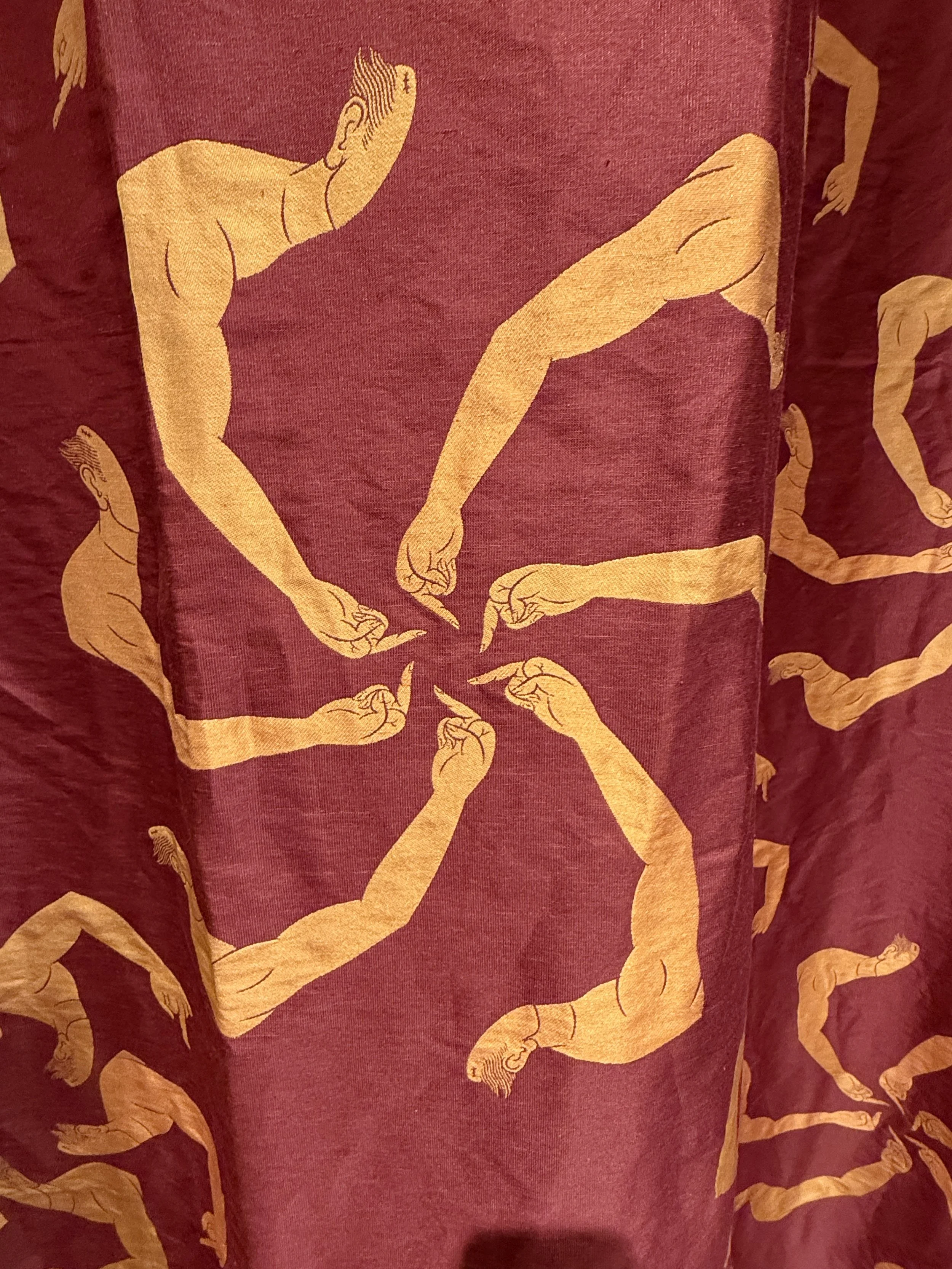
Arm “Rosette”
“Even protest, when brought into the language of interiors, has to be lived with”
What Design Can Carry
Walking out onto Via Fatebenefratelli and back into Milan Design Week, I carried the question the installation had left me with. What is design actually for? Decoration. Comfort. Status. Protest. Can it be all of those things at once?
Ai Weiwei and Rubelli together say yes. The sofa says yes. The monochromatic sheer that could hang in any beautiful home says yes. Design is not neutral. It never has been. The question is only what it’s carrying — and whether you’re willing to look closely enough to see.
I walked out thinking about what design can carry that other forms of expression cannot. A painting hangs on a wall. A sculpture stands in a room.
But a fabric drapes a body, covers a sofa, lines the walls of a space you inhabit. It gets closer than almost anything else. Which means what’s woven into it matters more than we usually stop to think about.
The most powerful rooms make you look twice. The first time you see what it is. The second time you see what it means. That’s not a trick. That’s design doing its deepest work.
Want to get a few quick wins in your interiors? Check out our complimentary guide below.